What is a parasitoid? a parasite?


When you raise Monarchs then chances are you have heard the words parasitoid and parasite before. What are they? Are they something specific just to Monarchs? Why are they such a ‘bad’ thing? Read on, and you will soon understand…

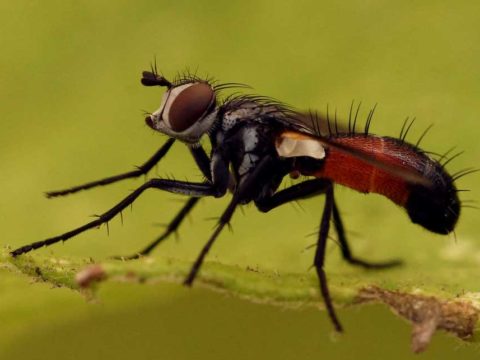
Parasitoids are specialized insects that lay their eggs on other insects. Parasitoid larvae slowly eat their prey from the inside out…(eeeew!! Can you imagine that one?), eventually (usually), emerging from the now dead prey either as a fully-formed adult or as a pupa. If you have had a Monarch chrysalis drop silky, jelly-like threads down to the ground and then little brownish ‘pellets’ fall from it, then you have witnessed this firsthand with the Tachinid Fly.

With Monarchs, Tachinid Flies and Braconid Wasps are pretty common parasitoids. In Southern California, I’ve seen more Tachinid Flies than Braconid Wasps prey upon the Monarch larvae. The predation occurs during the larval (caterpillar) stage. The Fly/Wasp will ‘sneak up’ on the caterpillar to oviposit. The mental image is enough to give this editor the heebie-jeebies.

A parasite is a micro-organism like a bacteria or virus or even a larger organism like a mite or fungus that completes either all of most of its entire life-cycle within its host (in this case, the Monarch). Not all parasites will kill their host but all have a negative effective on the life of the host. In other words, the host does not have much chance for survival once the parasite has had its way with it because the host is now weakened.

Some known parasites that Monarchs are prone to include Ophryocystis elektroscirrha and the Pseudomonas bacteria. The Oe protozoan can be easily detected under a light microscope and in fact, many Monarchs may actually show physical signs of infection early on.

Parasites are an ‘infectious disease.’ For example, a Monarch that has been infected with Oe has dormant spores throughout the scales on its wings as well as on its abdomen. As it flies, lands, and nectars on flowers or oviposits, it scatters diseased spores onto Milkweed. As larvae grow and eat, they ingest the spores which then germinate within them, and begin their own life-cycle within their new host, the unsuspecting caterpillar.

Special Note: Once a Monarch has been infected by a parasite/parasitoid, it will NOT recover or get better! Sadly, the damage has been done, and in order to halt the progress of parasite/parasitoid, the adult must be destroyed. In the case of Oe, the spores only develop when eaten by another caterpillar.

With the Pseudomonas bacteria, the Monarch dies a nasty death. In fact, there's even a name for it…Black Death. The look of this larva speaks for itself. The bacteria can kill during the larval or pupal stage.


Everyone has probably had a chrysalis at one time darken, thinking, "My Monarch is about to eclose!" only to find that days and days later, the butterfly hasn't emerged. Instead of giving up, you wait and wait, only to find that the chrysalis actually is a deep, dark black that then perhaps bursts with a putrid odour followed by a nasty mess of diseased...well, let's not go further, shall we?

How to prevent parasitoids and parasites from infecting your Monarchs
Just like with humans, cleanliness is key. For parasitoids like the Tachinid Flies, this is a bit more challenging. What I do is I try to keep an eye on my butterfly sanctuary (as much as humanly possible) and rid it of Tachinid Flies when I see them. All pupa are observed for any signs of Tachinid Fly parasitization (if you spot a dark or brownish spot on the green pupa during the two weeks, move that one to another location). If any silky, gelatinous strings 'fall' to the ground, destroy the pupa and the fly pupa that emerge.

With the Oe parasite I test ALL Monarchs that I raise before releasing them. If any show signs of the spores, I euthanize immediately.

I sanitize ALL equipment and rearing surfaces. This can help to keep bacterial and viral conditions to a minimum. I also try to make sure that the larvae are kept in as dry a condition as possible. High humidity leads to mold/bacterial/viral growth conditions so keeping all rearing conditions away from sun and heat is imperative. All containers are cleaned out at least twice if not more times a day. I do not put too many larvae in the same container either. Crowded conditions are not healthy in general.

The bottom line is: Be aware of what's going on with your Monarchs. If you do raise them, be smart and separate those that are not thriving so that they can be observed, and euthanize those that may transmit disease and illnesses.

FAQs (Frequently Asked Questions)

I have a question…

Does this sound like you? If so, check out the following, as they are questions that have arisen with regards to Monarchs.

1. I found this long string thing hanging from my Monarch’s chrysalis. What is it?
The string thing indicates that your Monarch caterpillar was a victim of a Tachinid Fly! If you wait long enough, soon you will probably see a puparium that will look like a brownish bean descend from the pupa. Your poor butterfly is dead. I’d squish the heck out of that brown thing or else you will end up with lots of those nasty flies just waiting to lay eggs on unsuspecting Monarch larva in your garden! Visit the post about Tachinid Flies.

2. My Monarch caterpillar isn’t moving. It stopped moving for a long time! I put it back on a leaf but it just won’t eat. Is it dead? Did I do something wrong?
Your caterpillar is probably getting ready to molt. Leave it alone! It needs time to shed its skin. Visit the post about molting.

3. I had all these Monarch caterpillars on my Milkweed outside but when I went to look again, they are all gone! What happened? I can’t find them.
Your caterpillars, if they were really big, probably are ready to pupate! When caterpillars are ready to pupate, they will often leave their host plant (the plant that they eat) to find a nice, peaceful spot. Many times, that spot may be WAY far away from where they were eating! Check around about up to 30-feet away. I bet you will find your caterpillars. It is kind of like one of those ‘I spy’ type of games. ☺

4. Should I keep my Monarch caterpillars sprayed with water? I read that they should be in a moist environment and that I should keep a wet paper towel under them.
NO! Absolutely not! Moisture + heat will breed all sorts of nasties (think mold, bacteria,…you get the picture!). Monarchs especially, are prone to all kinds of problems with molds and bacterial infections. Adding a moist environment to the mix will compound a potential problem. Keep their living environment dry. Make sure their leaves are dry, too! Only feed dry, healthy, FRESH food each day and make sure you remove all old food. If you spot any mold or decay, remove it immediately.

5. Are Monarchs carnivorous or cannibalistic? Will they eat one another?
Although Monarchs are not truly carnivorous they will eat one another on occasion in the larval stage! (EEEW! Yes, it is true!) More than likely, it is an accident, though, and a larger caterpillar will eat a smaller one because the little guy is on the leaf the big guy just so happens to be eating! It’s a case of being in the wrong place at the wrong time. The same thing can occur with eggs hatching at different times and a new hatchling eating an egg! Try to separate larva by instar (by size) and you shouldn’t have a problem.

6. My Monarch caterpillars keep dying! I am so good about sterilizing everything. What’s wrong? Am I a bad Monarch mom?
No, don’t be so hard on yourself. Keep in mind that the VAST majority of eggs laid do NOT make it to adulthood. If even 10% of the eggs one mama Monarch lays makes it to the adult butterfly stage, then that is REALLY outstanding! Predation, illness, parasitoids, parasites, and other causes are often the cause of death. Many larvae die in the very early instars. Just be diligent in your cleanliness in rearing these butterflies and you should be okay. Don’t give up.

7. One of my Monarch chrysalides fell! Is it dead?
Answer this question first:
Do you see any green liquid? If the answer is yes, then unfortunately, your butterfly is dead.
If no liquid came out then your butterfly is probably okay. You can carefully make a cushion of a few folded tissues sheets (like a little soft bed) and place the chrysalis on top. Make sure that when the butterfly ecloses, there is something nearby for it to climb up (is there a netting or a stick?). The butterfly will need to be able to climb UP to stretch and dry its wings.
It is NOT necessary to glue or tie the cremaster (the little black thing at the top of the pupa) onto something. Butterflies are pretty resilient as long as they have some way to climb up.

8. My caterpillar is throwing up. Is this normal?
Monarchs should not throw up. If the ‘vomit’ is green, it can be a few things. The food you are giving it could be poisoned (perhaps it was treated with a systemic insecticide). The caterpillar could be stressed out (did you have it out in the heat then brought it into an air conditioned room?). It could also have an infection.
Remove the caterpillar from any other caterpillar it may have contact with, to be on the safe side. Just iike humans, if it is sick, it can spread the illness to the others! Keep an eye on it. Monarchs should NOT throw up or regurgitate. Usually, this is a bad sign.

9. How do I euthanize a butterfly or caterpillar?
There are several ways to euthanize a sick butterfly or caterpillar. It depends upon what you feel most comfortable doing. Personally, I prefer the freezing method. Place the insect into a baggy, seal the baggy, then place it into the freezer overnight. Then, you can dispose of the baggy. The freezing temperatures will slow down the insect’s body functions.

10. How long does a Monarch live?
Butterflies do not have very long lives. Most live for about two weeks. Monarchs can live longer, if they are going to overwinter. (BTW, those that overwinter in Mexico or along the coast of California are NOT the same ones that started their journey! They are usually about the 5th generation that make it to the overwintering site.). Monarchs overwinter as butterflies (not pupa or larva or ova/egg).

Note on Photos & Content

All pictures and content on MyMonarchGuide are the copyright of tdogmom/MonarchFriend. Permission is granted for personal and educational use only.

some of the adorable clip art found on this website is used with the express written permission of D.J. Inkers